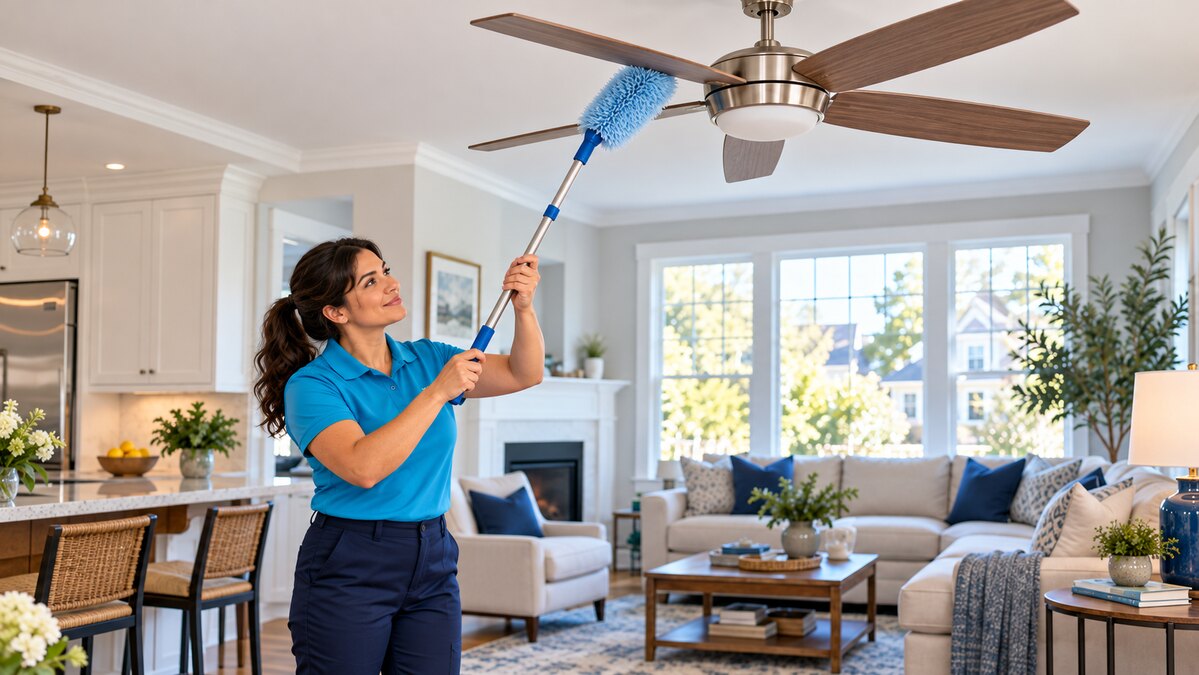
To dust ceiling fans and light fixtures without spreading dust, turn them off, protect the area below, and clean accessible surfaces before the room’s furniture and floors.
OVERHEAD DETAILS · GREATER BOSTON & NORTH SHORE
A fan can look clean from the floor while dust rests along the tops of its blades. Light fixtures also collect residue around shades and edges. In a Melrose home, Boston apartment, or North Shore condo, these overhead spots are easy to miss during an ordinary room reset.
The goal is a careful sequence, not a risky climb. This guide covers reachable surfaces and basic preparation, with clear limits for high fixtures, wiring, and delicate materials.
Before you dust ceiling fans and light fixtures
Turn the fan and light off. Allow bulbs and glass shades to cool fully before going near them. The Hunter Fan cleaning guidance recommends switching the fan off and letting light components cool before cleaning. Follow the instructions for your specific fixture, especially if it has a delicate finish, specialty shade, or removable parts.
Stand where you can work safely. A telescoping duster may help with a reachable fan, but do not lean from furniture, stretch beyond a stable position, or touch electrical parts. If the fixture requires a ladder, disassembly, or electrical work, arrange appropriate help rather than treating it as routine dusting.
Let the fixture become safe to touch
Turn the fan and lights off, wait for blades to stop, and let bulbs and shades cool. Check the maker’s instructions before touching a coated or fragile surface.
- Keep the fan off throughout the task.
- Do not touch hot bulbs or exposed wiring.
- Leave loose or damaged fixtures alone.
Catch dust before it reaches the room
Move small objects and cover furniture directly beneath the fixture if needed. Plan to clean the room’s lower surfaces afterward.
- Clear fragile items from the work area.
- Place a washable cover where dust may fall.
- Keep people and pets out of the area.
Work gently on accessible surfaces
Use a clean microfiber cloth or suitable soft duster. If your fan’s design allows it, contain dust from each blade instead of sweeping it across the room.
- Support a blade rather than pushing it hard.
- Use light pressure on shades and trim.
- Keep liquid away from motors and sockets.
Collect what settled below
After overhead dusting, wipe nearby reachable surfaces and clean the floor using a method suitable for its finish. Remove the cover carefully so dust stays contained.
- Check furniture and window ledges.
- Vacuum or dust-mop loose debris.
- Return objects once the area is clean.
How to approach different overhead surfaces
Ceiling-fan blades
Dust builds up on the upper face where you may not see it. If the fan is safely reachable, work one blade at a time with a soft tool, taking care not to bend or twist it. A pillowcase used gently over a blade can help collect loose dust, but it may not suit every blade shape or finish. Review the fan maker’s instructions before any damp wiping or use of a product.
Glass shades and reachable fixtures
Wait until all parts are cool. Dust the exterior with a soft cloth, taking care not to push on a loose shade. Do not remove glass, unscrew hardware, or spray liquid toward sockets as part of a simple room-cleaning routine. If a shade has heavy residue, check the fixture instructions or ask an appropriate specialist how it should be handled.
Fabric or decorative shades
Fabric can show water marks, and decorative finishes can scratch. A very gentle dry pass may be appropriate if the maker allows it. Test only where instructed and avoid applying a general-purpose cleaner to a material you cannot identify. A stained shade may need specialist care or replacement.
What order keeps the rest of the room cleaner?
Work from high surfaces to low surfaces. Dust the fan or fixture first, then nearby shelves, furniture, baseboards, and finally the floor. Cleaning the floor before the fan often means repeating the work once dust falls. If the room also has blinds, dust those before wiping the sill and glass.
In a kitchen, cooking residue may hold dust on a fan or nearby light. Do not use a strong degreaser without checking the finish and electrical safety requirements. In bedrooms and living rooms, a simple dry dusting may be enough for maintained fixtures. Every product and installation has its own limits.
A quick overhead-dusting checklist
- Identify the fan or fixture and read its care directions.
- Turn it off and let blades stop and bulbs cool.
- Check that the area is safely reachable without leaning or climbing.
- Move fragile items and protect furniture below.
- Lift loose dust gently with an appropriate soft tool.
- Finish by cleaning nearby surfaces and the floor.
For a broader room plan, review Moro Pro Cleaning’s services checklist. It is a starting point for discussing tasks, while the exact work depends on your booking and the accessibility of each surface.
When should you ask about professional cleaning?
If overhead dust has accumulated across several rooms, discuss accessible fan and fixture dusting while planning a more detailed home visit. Tell the team how high each fixture sits, whether it has fragile parts, and which areas are a priority. A deep cleaning service may be an appropriate conversation when other overlooked details need attention too.
For ordinary upkeep, recurring cleaning can help maintain agreed, reachable surfaces alongside kitchens, bathrooms, and floors. Never assume that a house cleaner will climb, remove a fixture, or perform electrical work. Confirm the scope before scheduling.
Frequently asked questions
Can I dust a ceiling fan while it is running slowly?
No. Turn it off and wait for the blades to stop before cleaning. This lets you control the dust and work around each blade safely.
Should I clean a fan before or after the furniture?
Clean the fan first. Then wipe the surfaces below and finish with the floor so fallen dust does not undo earlier work.
Can I spray cleaner onto a light fixture?
Do not spray toward sockets or electrical parts. Follow the fixture manufacturer’s directions for its material. A simple dry dusting is often a better starting point for accessible exteriors.
Does a deep cleaning include every ceiling fixture?
Not automatically. Height, access, fragility, and the service selected all matter. Identify the fixtures you want addressed and confirm the work in advance.
Plan a more complete room refresh.
Moro Pro Cleaning is based in Melrose and serves homes across Greater Boston and nearby North Shore communities. Tell us about your rooms, reachable fixtures, and priorities so we can review the right cleaning service.
Prefer to talk? Call (781) 720-9118.


A Cleaner Home Starts Here
Professional cleaning based in Melrose and serving Greater Boston. Explore your options and book online when you're ready.